




Kennedy vs. Other U.S. Half Dollars: A Technical Comparison of Design, Metal, and Market Behavior
The Kennedy half dollar is the most familiar of all U.S. half dollars. The series has a long timeline, several metal groups, and wide public recognition. It also provides a clear benchmark for evaluating earlier half-dollar designs.
Collectors often compare these series to understand how metal, rarity, strike quality, and demand shape market behavior. So, here you can find a comparison based on technical traits, survival patterns, and observed liquidity.
Kennedy Half Dollar Basics for Comparison
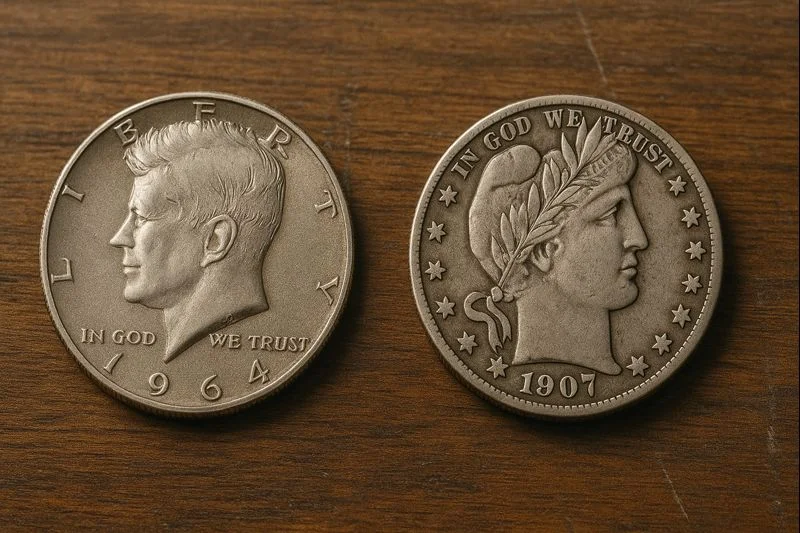
The Kennedy series began in 1964. Production started quickly due to national attention, which affected early strike characteristics. The design by Gilroy Roberts (obverse) and Frank Gasparro (reverse) became one of the most recognizable motifs in modern U.S. numismatics. Metal composition changed several times. The series includes multiple strike types and several notable varieties.
Kennedy halves circulate in large quantities, especially clad issues. Silver groups circulate less but remain common on the secondary market. NIFC coins, issued since 2002, appear mainly in collector channels. This combination creates a complete spectrum for comparison with older half-dollar types.
Analytical Overview of the Series
Main structural features:
- 1964: 90% silver, circulation and proof.
- 1965–1970: 40% silver, circulation, and SMS.
- 1971–2001: Copper-nickel clad, circulation and proof.
- 2002–present: Copper-nickel clad, NIFC, and proof.
Strike types include business strikes, proofs, SMS coins, and NIFC issues. Varieties such as Accented Hair, 1972-D No FG, and 1974-D DDO provide diagnostic markers useful for technical comparison.
Core Characteristics of the Kennedy Half Dollar
| Parameter | Value |
| First year | 1964 |
| Designers | Obv: Gilroy Roberts / Rev: Frank Gasparro |
| Metal groups | 90% silver, 40% silver, clad |
| Diameter | 30.6 mm |
| Weight | Varies by composition |
| Edge | Reeded |
| Strike types | Circulation, Proof, SMS, NIFC |
| Key varieties | Accented Hair, 1972-D No FG, 1974-D DDO |
The Kennedy series spans multiple minting periods with consistent design and clear metal groups. Its documentation is extensive, making it easier to analyze patterns in grading, value, and survival. The design is detailed but readable, providing clear markers for wear. These characteristics allow collectors to compare it with earlier series in a structured way.
Comparison Framework: What Parameters Matter
A responsible comparison requires a defined set of technical factors. These parameters appear across all half-dollar series and determine long-term market behavior.
Metal composition: Silver content influences melt value, durability, toning, and overall demand.
Surface stability: Some alloys resist wear better. Others show smoother surfaces but lose detail faster.
Availability across grades: High-grade pieces of older series often appear rarely. Kennedy halves offer a broader distribution across grades.
Rarity by date or type: Certain years or mint marks show limited survival.
Collector demand: Series attract different audiences. Some appeal to beginners, others to advanced specialists.
Market liquidity: Coins with familiar designs and large surviving populations trade more easily.
Entry cost: The price range determines how quickly a collector can assemble a representative set.
Like many other collectors, you can also rely on a coin values app to compare price ranges across series. These tools help estimate typical values and basic minting details, but do not replace inspection of surface, detail preservation, and strike quality. These factors above ensure that comparisons remain technical and consistent across the Barber, Walking Liberty, Franklin, and Kennedy series.
Barber Half Dollar: Metal, Strike Characteristics, and Market Role
The Barber half dollar has a distinct position among U.S. silver coinage. The series reflects a late-19th-century design philosophy and shows wear patterns unique to its era.
Historical Context
The Barber series was minted from 1892 to 1915. These coins use a 90% silver alloy with a classic portrait on the obverse and a heraldic eagle on the reverse. Mintage levels vary widely across dates. Many issues entered heavy circulation and remained in use for decades. As a result, surviving high-grade pieces are limited.
Metal and Wear Patterns
Barber halves show deep wear on high points due to heavy commercial use. Cheek contours flatten early. Reverse feathers lose detail even under moderate circulation. The series often appears in Good to Fine condition on the market. Fully detailed pieces command strong premiums because they rarely survive.
Rarity and Market Behavior
Collectors note wide price spreads across grades. Low-grade examples remain affordable, but high-grade pieces, especially AU and MS, show considerable scarcity. Demand comes mainly from specialists who appreciate the historical context and difficulty of assembling a complete set in high condition.
Market volatility is moderate but stable. Exceptional examples draw attention because of small populations.
Comparison With Kennedy
Barber halves differ sharply from Kennedy halves:
- Survival rates for high-grade Barber coins are low.
- Both series share 90% silver for part of their production, but Barber coins show heavier wear and fewer preserved specimens.
- Barber halves attract advanced collectors; market liquidity is narrower.
- Entry costs exceed Kennedy levels due to grade scarcity.
This makes the Barber series technically challenging and fundamentally different from the accessible Kennedy series.
Walking Liberty Half Dollar: Design Strength, Silver Appeal, and Collector Demand
Walking Liberty halves are widely regarded as one of the most detailed and artistic U.S. designs. Their market behavior reflects this complexity.
Series Background and Key Traits
Minted from 1916 to 1947, these coins use a 90% silver alloy and feature a high-relief obverse design. The reverse eagle shows distinct feather structure. Strike strength varies significantly across years. Many issues present soft strikes even in uncirculated grades.
Market Behavior and Collector Trends
Walking Liberty halves attract both silver buyers and numismatists. Mid-grade coins remain accessible. High-grade coins show significant scarcity due to widespread circulation and strike challenges. Toning and surface quality influence price heavily.
The series maintains strong long-term demand. Its design and silver content appeal to collectors who appreciate artistic detail.
Comparison With Kennedy
Several contrasts appear:
- The Walking Liberty relief is deeper and more complex, making the design sensitive to wear.
- The series is older; rarity levels for high grades exceed Kennedy levels.
- Demand comes from both general collectors and design enthusiasts.
- Liquidity is stable but depends on conditions, with price gaps between grades larger than in the Kennedy series.
Walking Liberty halves remain one of the strongest silver series in terms of long-term interest.
Franklin Half Dollar: Simpler Design, Clear Markets, and Predictable Price Behavior
The Franklin half dollar offers a transition between classic and modern coinage. Its clean design produces distinct strike characteristics.
Series History and Design Notes
Franklin halves were minted from 1948 to 1963. The 90% silver composition remained consistent. The obverse shows Benjamin Franklin, and the reverse features the Liberty Bell. The design is flatter and shows fewer high-relief points than the Walking Liberty coins.
Market Traits and Rarity Patterns
Franklin halves show balanced availability. Most dates remain common in mid-grade. The key technical focus is Full Bell Lines (FBL), which indicates strong strike quality. FBL examples show sharp detail across the base of the Liberty Bell and command premiums.
Market behavior is predictable. The series offers clear grading boundaries and steady collector interest.
Comparison With Kennedy
Important contrasts include:
- Franklin halves show fewer varieties than Kennedy halves.
- FBL status introduces a technical focus unique to the series.
- The series is older but has wide availability in high grades.
- Entry costs range from low to moderate.
- Demand is steady among collectors who value consistent design and clear grading criteria.
Franklin halves often serve as a structured entry point into earlier silver coinage.
Comparison Table: Kennedy vs Other Half Dollars
| Factor | Kennedy | Walking Liberty | Franklin | Barber |
| Metal | Mixed (silver, clad) | 90% silver | 90% silver | 90% silver |
| Design complexity | Medium | High | Low/Medium | Medium |
| Circulation survival | High | Moderate/Low | High | Low |
| Rarity by grade | Moderate | High | Medium | Very high |
| Market demand | Broad | Strong among specialists | Stable | Specialist-heavy |
| Price range | Wide | Wide | Moderate–High | High |
| Entry difficulty | Low | Medium | Medium | High |
Explanation: Kennedy halves remain the most accessible due to an abundant supply across grades. Barber halves are the most difficult because few high-grade coins survive. Walking Liberty halves show strong artistic appeal but require careful evaluation due to strike variability. Franklin halves create a structured path with clear strike indicators such as FBL.
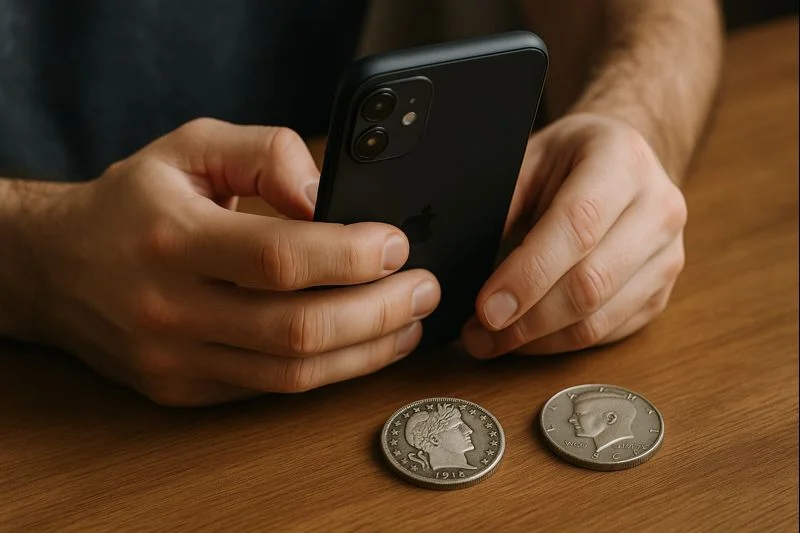
Tip: If you are new to coin collecting, refer to digital tools for quick sorting and price referencing. The best free coin identifier app should be easy to use and have a great database for comparison. So, opt for Coin ID Scanner, for example. It has more than 187,000 coins in the database and supports metal recognition, minting details, and date range identification.
The tool helps verify characteristics across different half-dollar series, reducing sorting time. However, manual inspection remains essential for grading, variety confirmation, and surface evaluation.
Final Words
Each half-dollar series holds a specific place in U.S. numismatics. The Kennedy half dollar provides a modern baseline with accessible price levels and clear documentation. Walking Liberty halves show strong visual complexity and stable long-term demand. Franklin halves offer predictable markets and structured grading with the FBL designation. Barber halves remain the most challenging due to wear patterns and limited high-grade survival.
Understanding these differences helps collectors evaluate metal value, rarity, and strike quality with precision. Knowing these nuances helps collectors to make better decisions when purchasing, upgrading, or comparing coins across the U.S. half-dollar series.